Sunday, March 31, 2013

Badusha treats for Phagwah (Holi)


What a weekend!

We are fortunate to have two public holidays and an extra long weekend to celebrate. This year we have a bit of an unusual situation as other holidays also fall within this Easter weekend so let me say Happy Easter,  Happy Shouter/Liberation Baptist Day and Happy Holi!


Before I continue I must say thank you to my friend Gareth Leigh for very kindly allowing me the use of his images of Phagwah.

In Trinidad the festival of Holi is called Phagwah. We don't have any sweets as such that are associated with it however I discovered that in India sweets made with bhang are popular at this time. Bhang, by the way, is cannabis.

Hmmmm.

Right, so in lieu of that I bring you something a little less exciting, the consumption of which is not likely to land you in jail.

I loved these Indian treats. They were quite reminiscent of  Trinidadian fat kurma. It takes a little effort to make the pleats but if you are not so inclined to go through the trouble, just shape them as flattened balls with a slight indentation at the top.


Badusha

Ingredients

Makes 8 - 10

1 1/2 cups flour
1/4 cup ghee or butter at room temperature
1/2 tablespoon vegetable oil
2 tablespoons Greek yoghurt
1/2 tsp baking soda
1 tsp sugar
1/4 cup water ( or more- adjust accordingly)

Oil for deep frying

Sugar Syrup
1/2 cup sugar
3/4 cup water
pinch of cardamon
2 strands saffron*optioanal
1/4 tsp ginger
3/4 tsp of lemon juice

METHOD
Melt the butter/ghee. In a mixing bowl add melted butter, yogurt, oil, baking soda, and sugar.

Add the flour and mix well with a whisk. It should look crumbly like bread crumbs. Add water a little at a time to form a soft dough. Knead for 10 mins. Divide into lemon sized balls. Cover and set aside. Let rest for 10 mins.

Shape the badushas with decorative edged swirls or flatten the balls slightly and make a dent in the top with your thumb.

Here is a video to illustrate how the swirls are done.


Heat oil (medium high heat) in a frying pan. Check oil by adding a pinch of batter. If the batter rises quickly then it is the correct temperature. Fry the badushas 3 at a time, turning the heat down occasionally so that they do not burn and are cooked through the middle.

Line a tray with foil. Grease the foil with butter and set aside.
Add sugar, cardamon, ginger and water in a pan to make the sugar syrup. Cook on medium-high heat until the syrup makes a long, slow, string when your spoon is lifted. Quickly add the lemon juice ( to avoid crystallization).

Dip the badushas in the sugar syrup turning until coated on both sides. Transfer to the tray with the buttered foil. Once the glaze has dried you can store them in an airtight container for a few days.


Thursday, March 28, 2013

Jamaican Red Snapper Stew - Photo Update

Fish becomes the star ingredient in many Trinidadian homes during the season of Lent. Tomorrow being Good Friday we will be having Fish Broth. While planning for that I was reminded of the meal in the picture below. I was never satisfied with my initial images of this dish so I retook the photo. As you can see from the date I forgot all about posting it. Better late than never, I guess. The recipe can be found here


Saturday, March 9, 2013

Trinidad Green seasoning


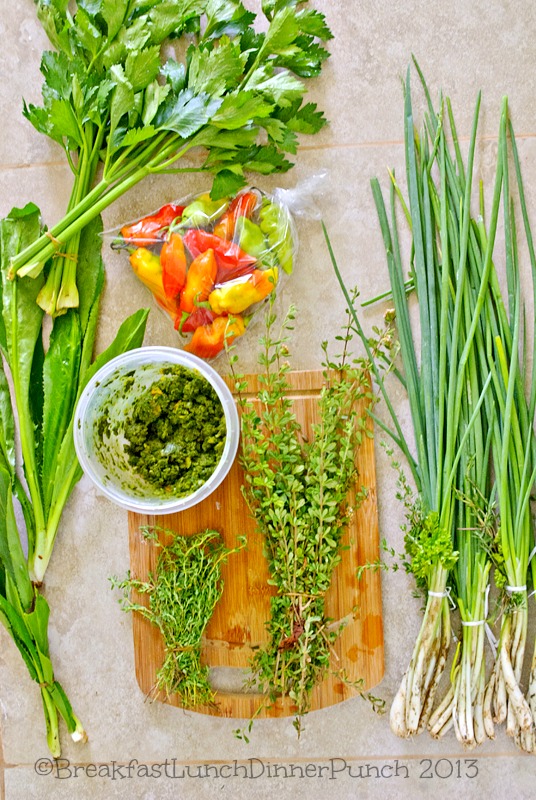
The foundation of cooking meat the Trinidadian way is all about the seasoning. All meat (beef, chicken pork and fish) is marinated in a seasoning mix of crushed herbs, onions, garlic and peppers. This blend of herbs and aromatics is called 'green seasoning'. It is incredibly versatile and is good in soups, stews, rice, and bean dishes. Many Trinidadians whip up a batch of this stuff on a weekly basis. The blend of seasoning is based on personal preference and varies across households. Traditionally some or all of the following ingredients are used: 


 Celery 
There are three kinds of celery that are grown for cooking purposes.
Stalk celery is imported into this country from America and it is grown for its crunchy stalks which can be eaten raw. 

Leaf celery (pictured above) or Chinese celery is grown primarily for its leaves which are used as a herb. The stem is also edible raw but much more pungent than stalk celery. The stalks of leaf celery taste better cooked. This type of celery is a key ingredient in Trinidad green seasoning and both leaf and stalks are used.

Root Celery also called celeriac is grown for its bulbous root. It is not available in Trinidad.


Culantro
The Trinidadian name for culantro (Eryngium foetidum) comes from french settlers to the island during colonial rule. Chardon béni which Trinis pronounce as shadow benny means blessed thistle. Although not the same plant it's appearance is somewhat remniscent of the blessed thistle plant (Cnicus benedictus) that is native to southern France. 

Bhandhania is the other local name for culantro and it comes from the large East Indian descended population. Dhania comes from the Hindi word for coriander seed. It must be noted that culantro is not related to the coriander plant (Coriandrum sativum). Interestingly, both plants have the same smell and taste with culantro being the more intensely flavoured of the two. Use twice as much cilantro if substituting it for chardon béni in your recipe. 

Across the Caribbean it is also known as Chardron benee (Dominica), coulante (Haiti), recao (Puerto Rico) and fit weed Guyana).


Portuguese Thyme

I expect that I might be the last remaining Trinidadian who remembers that this was once called Portuguese thyme, so called because this is used in Garlic Pork (the local version of Carne de Vinagre e Alhos). Garlic Pork is a traditional Portuguese West-Indian Christmas dish.  Over the years Trinidadians started calling this Spanish Thyme which is very confusing because there is another herb that is also called Spanish thyme. 


I remember consulting my grandparents the very first time I made garlic pork. I have fond memories of my 2nd generation Portuguese grandparents guiding me through the process and instructing me that I was to use Portuguese thyme. It is also called by this name in the first locally published cookbook, Sylvia Hunt's cooking: Proud Legacy of our people. Whatever the correct name might be, I will continue calling this herb Portuguese thyme if only for sentimental reasons and remembrances of my grandparents. 


So that there can be no confusion, its botanical name is Lippia micromera and it also goes by the name of False Oregano. In the United States it's called Mexican Oregano. Even thought it smells and tastes very similar to true oregano, the plant is actually more closely related to lemon verbana. The flavour is a little more intense than true oregano so a little goes a long way. 


French Thyme (thymus vulgaris) 


Spanish Thyme (Big Leaf Thyme)

The final variety of thyme that Trinidadians love to throw into this mix is Spanish Thyme (Plectranthus amboinicus). Yet another thyme that is not a thyme but we call it thyme anyway. Yikes!  It's other local name is big leaf thyme because of its broad leaves. I don't often include this one in my green seasoning mix. 


Still confused by the various types of thyme. Here is a photo taken from the blog of my good friend Cynthia and used with her kind permission. This should make it easier for you to identify the different varieties.

Spanish thyme is another herb with an oregano-like flavour. It is even more strongly flavoured than Portuguese thyme and because of the similarities I find it unnecessary to use both at the same time. It can overpower if used too liberally. When I do use it, it's never more than a leaf or two as it has the tendency to darken the seasoning mix and turn dark green to black. I prefer to see a brighter green mix.


In Trinidad no distinction is made between Green onions or scallions and chives. They are all called chives (local pronunciation Sigh-ve ) and are used interchangeable in the making of green seasoning. My preference is for  the slightly more onion flavour of the scallions for my marinade. 


Trinidad pimento peppers 
Trinidad pimento peppers are also known as seasoning peppers. I would have to say that pepper is adored by Trinidadians and is easily the most popular cooking pepper in our country. Unfortunately it is little known outside of the Caribbean or places that have a large West Indian population. The flavour is really impossible to describe. When you cut it it smells like its going to be hot and I suppose it can be said to have the flavour of a hot pepper but without the heat if that makes sense. It is most definitely not a sweet tasting pepper like a bell pepper. Some people will also use scotch bonnet peppers. 

Before I begin, let me assure you that there are no standard amounts for this recipe. I usually judge if it is right by smell not taste. After awhile you will develop a sense of what is right for you. 


Trinidad Green Seasoning
Yeild 9 ( approx 2 cups)

4 bunches leaf celery
2 bundles culantro ( or 4 bunches cilantro)
1 bundle Portuguese thyme - 12 stalks or so ( or substitute with oregano )
2 bundles French thyme
3 bundles of scallions (or chives)
10-12 Trinidad Pimento peppers ( substitute banana peppers)
2 leaves of big leaf thyme (optional)
1 head of garlic ( about 10 cloves)
1/8 - 1/4 cup water or *vinegar  (*optional-  this preserves the seasoning mix if it is to be kept in the fridge longer than a week) 


Method
Wash the herbs and de-seed the pimento peppers.
Rough chop all ingredients and put into a food processor or blender.  Puree the herbs adding a small amount of water, vinegar or lime juice so that mixture can turn easily in the processor. The consistency should be that of a chunky pesto. Some people prefer a more watery blend it's up to you. 

Green seasoning can also be frozen in an ice tray. You pop out a cube or two when needed. If freezing you can omit the vinegar. You will find that over time the colour darkens in the fridge. This is normal and it is perfectly fine. 


Tuesday, February 12, 2013

A move forward and a look back

I know it seems like once again I have fallen off the face of the earth. I haven't. However last month we moved house and the new place doesn't yet have an Internet connection. Not having access to the Internet is a bit like falling off the earth, isn't it? 

Seriously, phone company you could have told us when we applied for service that your technicians don't 'fish' for cable. It would have saved everyone a huge waste of time. Cable guys we have called it in four times and told your office that the house is 200m from the road. Three 3 different guys have come by and still, no hook up. Sheesh! Walk with enough cable, already! 

Honestly, a month without any kind of technology and we are all like "Goodnight John-Boy," up in here. 

So how did we get here? Well two years ago, my husband and I purchased what we optimistically called a fixer upper. Looking back at this photo, I am willing to concede that might have been a-glass-is-half-full, kind of description.

The reality was actually a nightmare of  exposed wiring, bare concrete floors and walls that were clearly once inhabited by the crooked man of English nursery rhyme fame.

But see, here is the thing... on the day we went to view the house, we saw this first.


Can you say SOLD!

Its funny at the time I wrote this post we had no idea that we would ever have anything more than a postage stamp, sized garden. Now that we are staring at the the reality of something more, we are starting to question our sanity. Words like insane and crazy have been tossed about but I prefer the term visionary :-) Apparently so did the bank.

It would seem that my husband and I are in possession of some mad powers of persuasion. No one was more surprised than we were when we managed to secure financing for this project. This was achieved in part by waving this picture around and describing the surrounding scenic views of green hills and the lush vegetation.  


Hey did we mention the view of the waterfall from the front porch? 

Okay, so most days its a small spring but on rainy days the mountain opens up and it is quite spectacular. 

Interior renovations are complete and we have moved in. Most of the 'neighbours' including this magnificent falcon have already popped by for a meet and greet.

Understandably our first meals here were quite simple. The kind of thing that doesn't need a recipe. This is a simple red pear, walnut salad that I topped with pomegranate seeds and served with a store-bought strawberry balsamic vinaigrette. Being surrounded by all this green makes me think of salads and wholesome meals.


A lot of work remains to be done on the outside of the house but my new kitchen is a dream. Hopefully it won't be long again before we have an internet connection and I look forward to sharing with you the meals that come out of it as we settle in.

Tuesday, January 1, 2013

Jamaican Christmas Pudding


Nothing makes us yearn for home and family like a recipe that has been handed down for generations. That is why when my friend Debra told me that she was teaching her church group in Dallas how to make her grandmother's Christmas pudding I jumped at the opportunity to ask her for the recipe. I am excited beyond all belief at this share.....I remember this pudding so well!  I know all thoughts of Christmas are well and truly out our minds now that the New Year is here but believe me this is a recipe you will want to bookmark for a special occasion as it is truly and indulgent treat.


Season's Greetings to everyone. I am doing a "guest blog" for Wizzy this week -which might on some level imply that I am a blogger with my own blog just around the corner for BLDP, just jumping in while the season is right. However in the interest of full disclosure I must confess right off the bat -I am NOT a blogger, nor a photographer. So with those confessions out of the way, and hopefully your indulgence -let's proceed shall we?

My Mom, who Wizzy has mentioned on this blog - is a self described Jamidadian- a transplanted Jamaican, living in Trinidad. So of course, our house was a bit of an oddity when I compared notes with friends at school and neighbours. Most of those differences faded away as our house became a truly Jamidadian house. However, Jamaican Christmas Pudding was one thing that never received the Trini touch. 

In Trinidad over the holiday season, it is a time for celebrating family and friends. You can expect friends to drop by all December long. You paint the curbs, the front walls, clean top to bottom and prepare the house for lots of through traffic. Some visits are long and go all into the night and some are just a a brief moment to touch base with someone you don't see that often -but you exchange a hug, have a drink and eat some Christmas cake. It is storied that for each different piece of cake you eat, you will receive a month of good luck in the coming year - so visits abound! 

At our house my Mom made both a cake and pudding as the recipes are two halves of the same coin, both starting with a full crock of dried fruit that have been soaking in rum and cherry brandy since June or July. My mom's recipe made 4 large cakes/puddings and she grew up making 2 cakes and 2 puddings from the one recipe. Each time someone would come to the house my Mom would ask "Would you like some cake or pudding" and the answer was always "Yes please. Pudding please".  It didn't take my Mom long to start making 3-4 puddings. 

You must be wondering what is the big difference between a Christmas cake and a Christmas pudding. Surely it must be a hugely dramatic production to make a pudding instead of a cake. The differences are slight and subtle, yet the end result is dramatically different - a contradiction, I know. The differences are one of texture because the pudding is steamed and of alcohol content because the pudding is steamed covered and the alcohol does not cook off as it does with a cake and just to be sure, the pudding is "fed" every couple of days with rum or brandy and served with a hard brandy or rum sauce. 

It is a rich treat, served in small slices between friends, as you pause from the hustle and bustle of the season to take the time to visit with each other -often with much merriment and mirth.


Grandma Mae's Jamaican Christmas Pudding
Yield: Four 8-9" cakes

1 lb raisins
1 lb currants
1 lb prunes
1/2 lb dates
1/2 lb mixed peel
1 bottle cherry brandy/prune wine (note: Cherry Brandy is a Caribbean wine that has less than 10% alcohol and isn't truly a brandy)
1/2 lb cherries
1 lb dark brown sugar
1 lb butter
1/2 lb flour
1/2 lb bread crumbs 
2 tsp baking powder
1/2 cup rum
1 dozen eggs (8 whites and 12 yolks)
Nutmeg
Cinnamon
Rose Water (can be tricky to find -use an English brand -not a Japanese brand)
Browning
Vanilla

Method Grind raisins, prunes, dates and mixed peel. Add currants (whole). Soak in liquor ( for 1 -18 months typically. Although my recent batch had been soaking for 6 years!! )

Find a baking tin with a tight fitting lid. I use those decorative tins from the craft stores as this is a low temperature affair and the pans are well lined. Grease the pans with butter. Line the bottom with wax paper - being sure to bring it up the sides a bit. Double line the sides by folding a long piece of wax paper in half and placing it creased side down in the tin. And then line the bottom again. And then grease and flour the lined pans. 

Cream butter and sugar. 

Finely dice cherries -they should be smaller than the currants!! 

Add 2-3 caps of rose water -add it until the butter and sugar smell like rose water. 

Beat 8 egg whites with a lime peel until very stiff. Don't use a mixer as the lime peel needs to be removed and the mixer tends to chew it up.

Add 1 dozen egg yolks -one at a time to the whites

Add 1/2 cup of rum

1 tsp of vanilla, nutmeg and cinnamon -sprinkled across the top of the mixture

Fold in the butter and sugar

Add cherries and fruit and mix in gently

Add browning until the batter is a rich dark brown colour -being careful not to make the batter too thin.

At this stage you may need to make adjustments. The batter is the right consistency when a wooden spoon stands up in it -fully vertical without help. Because the fruits soak for various lengths of time, and browning is sometimes thinner than other times the exact amounts my vary and you may need to add a bit more flour/breadcrumbs mixture -but not much. I seldom have to do this because I have very rich smelling rose water and I would rather have a lighter coloured cake, so I'm very stingy with the browning if it is too thin. 

Use a saucer to pan the mixture into prepared pans -a ladle would work too, but using a teacup saucer is much faster. Whatever works for you but do not just pour it from the mixing bowl! 

Place a piece of wax paper of the top of the pan and press the lid down to seal the pan with the batter.

Bake in an oven at 250* with a water bath/pan full of water in the oven (do NOT place the pan in the water) -for 2-2 1/2 hours. Be sure to check the water every 45 mins or so to make sure it hasn't dried out. 
It is done when it springs back and the pudding has pulled from the sides


When it comes out pour 1/4 cup of sherry or brandy over the top of each pudding and replace the lid. 
It is stored at room temperature -adding more sherry or brandy every week or so. 
And to serve it -cut off a small portion and serve with a hard brandy sauce -which is basically just butter, fine granulated sugar and a bit of sherry or brandy. 

Cooks note: This makes a TON of pudding/cake. Typically I soak a whole recipe of fruit but bake a half recipe of  pudding at a time. If making to give as gifts the this will yield approx six 6" cakes