Showing posts with label Caribbean. Show all posts

Tuesday, March 4, 2014

Trinidad Fish Stew


I haven't been on this blog for a long while and I am almost but not quite sorry. I always miss blogging when I have been away from it but at times it is important to show up in other places of my life where I am needed a bit more. One of those places has been my garden. Long time visitors to this site may remember this dream of mine. I am happy to report that my journey to producing some of my own food is becoming more real. Perhaps one day soon some of the dishes on this blog might even showcase produce that I actually grew myself. 

Tomorrow is Ash Wednesday and after today's Carnival celebration many Trinidadians will be headed to mass to receive ashes. In keeping with Lenten tradition, many homes will prepare a meal of fish.  

This stewed fish recipe is a favourite of mine and in many homes it is often served with cou cou. Trinidadians usually fry the fish first before adding it to a tomato based stew. When this done, it is called by the odd name of Stew Fry Fish to distinguish it from the version where the fish is not fried but added directly the sauce. My preference is to fry first.

Trini Stew Fry Fish
1lb fish (bangamarie)
* other fish like flying fish, king fish, carite, carvali, tilapia can be used

4 tablespoons green seasonings
1 tsp salt
juice of one lime
1  cup flour
oil for frying

Golden Ray cooking margerine or butter
4 goves garlic minced
2 large onions, sliced
3 medium tomatoes sliced
1 bay leaf
1/2 cup ketchup
1/2 tsp mustard
1 teaspoon sugar
1/2 cup water
1/2 teaspoon curry powder
1/2 teaspoon West Indian pepper sauce (optional)
8-10 Trinidad pimento peppers seeded and finely sliced


Season fish with salt, lime juice,  and green seasoning. Leave in fridge to marinate for 30 minutes. Mostly I do this the night before so that when I get home from work the fish is ready to be cooked. If seasoning the fish overnight I will omit the lime until just ready to cook.

Heat enough oil for deep frying the fish in a large pot on medium high heat. Fry the fish and set aside on paper towels.

Once all the fish has been fried, melt the butter  in a large and fairly deep skillet with a tight fitting lid..

To the butter,  add the curry, garlic, onions, tomatoes, celery, and cook until nicely fragrant. Add the ketchup, mustard, sugar, water, bay leaf and stir to combine. Bring sauce to a simmer.

Add the fish and pimento peppers to the sauce, cover and simmer about 5 minutes just until the fish is warmed through. Taste and adjust salt if necessary.


Sunday, December 15, 2013

3 Vegan Recipes that pack some punch

Food bloggers spend a lot of time reading other blogs for inspiration. I met vegan / raw food blogger when she contacted me to have me create a photo for her recipe book The Joy of Raw and Vegan Cooking which is available now on Amazon. Follow the link to preview her book which features some beautiful photographs. Also, you will not be disappointed to discover Shernell's blog where she shares her passion for raw food.

I am not vegan but I am always concerned about healthy eating. Often,  I will include vegan or vegetarian meals on my table. Shernell  now resides in New York but her food is still big on island flavour which everyone is sure to enjoy. Hers is one of the blogs that I turn to when I am looking for vegan inspiration with a West Indian twist. Over now to Shernell......


Hello all you readable feast lovers out there! My name is Shernell, and I’m a passionate vegan cook from the island of Barbados. I love making all my food from scratch, however I believe in simple, easy to find ingredient recipes. I have been invited here to share three of them from my new cookbook The Joy of Raw and Vegan Cooking with you. So enough with the long talk and enjoy.

First up I have a recipe that has been known to turn meat eaters into vegans. Flavor is everything when cooking any meal, vegan or not. These cauliflower steaks are dripping with succulent barbeque flavor.


Barbeque Stewed Cauliflower

If you’re new to raw and vegan foods and you miss meat, this easy recipe is for you.

1 tablespoon salted barbeque spice mix
2 tablespoons olive oil
2 sundried tomatoes
½ red bell pepper
1 tablespoon maple (or agave) syrup
½ lemon juice
3 tomatoes
1 head of cauliflower cut into medium florets

Blend the first seven ingredients in your blender and then pour over the cauliflower florets.
Mix the sauce into the florets well and put into a roasting pan.
Roast for 30 minutes or until the cauliflower is tender and then serve.

If your barbeque spice mix isn’t salted, add 1 teaspoon of salt ( or salt to your taste)  to the recipe. 


Second up we have the best tasting green smoothie ever made. That’s right, Shernell says so.  It makes for a great meal replacement.


Best Green Smoothie

I made this recipe over one hundred times; it is so delicious and easy to make.


2 cups fresh organic spinach
3 frozen bananas
1/3 cup cashews
¼ teaspoon salt
3 tablespoons of maple ( or agave )syrup 
1 cup water

Blend and serve. Makes about three cups.


If you take your time to make this recipe you will be in cake heaven, guaranteed. Yes I did save the best for last. 


Chocolate Hazelnut Mousse Tart

No Exaggeration, this is the absolute best raw dessert I have ever had hands down. Please make it and prove me right. It’s light and airy with smooth chocolate and hazelnut flavor.

Crust
1 cup cashews
1 cup almonds
2 tablespoons of chocolate powder
¼ teaspoon of salt
7 medjool dates
½ teaspoon of vanilla extract

Process the first 4 ingredients in your food processor until flour like then add in the dates and vanilla extract and process until the mixture sticks together.

Press the pie crust into a 10-inch removable bottom tart-pan and place it in the freezer.


Filling

The meat of two young Thai coconuts
11/2 cups coconut water
1/3 cup cashews
1/3 cup of chocolate powder
1/3 cup maple ( agave ) syrup
¼ teaspoon of salt

Blend all the ingredients until creamy and place in the refrigerator in a medium bowl.

Hazelnut Topping


¼ cup of hazelnuts
¼ cup of cashews
2 tablespoons of chocolate powder
1/2 cup of maple syrup
2 teaspoons of coconut oil
1 teaspoon of vanilla extract
¼ teaspoon of salt
1 cup of hazelnuts


Blend the first 7 ingredients in you blender until creamy then set it aside.

To assemble the tart, pour the filling over the crust then pour the topping on and
evenly spread 1 cup of hazelnuts over the tart.

Freeze for 3 hours and serve. Its lasts for one week in the freezer, but trust me, it won’t
last that long.

Have a happy and healthy holiday.

To find out more about Shernell Cooke, visit her at her blog The Raw Food Beginner Chef.  You can also purchase her book The Joy of Raw and Vegan Cooking on Amazon or Barnes and Nobel. 

Monday, August 26, 2013

Fat Pork Jam


It has been a fruitful holiday. We have been stuffing our faces with mangoes, West Indian cherries, yellow plums, and guavas. Wars are being fought over the few remaining sugar apples. 


One  uncommon fruit which we found on a drive through the country side was fat pork.  Bite into it and the unusual texture of it's interior, white pulp will clue you in as to the name. The taste is insipid and to be honest it doesn't inspire a second bite. It looks it but doesn't taste like pork fat. The weird, floury texture is only very mildly sweet with a flavour that is barely detectable. The rest of the Caribbean calls these fruit cocoplums. It is something that I remember foraging as a child, although now I cannot for the life of me remember why! 


Foraging, apparently it's a thing. Back when I was a child. It didn't have a name. It was just something we did. Mom and Dad you might want to look away for this part. Sampling little bits of wild, edible, plants and their fruits was a childhood game which was meant to gross out friends. 

Does anyone remember eating the transparent seed coat of the Pride of Barbados seeds? We called it Dead Man's flesh. Yum. There is that 'ick' factor that's so gosh darn appealing to kids~ especially boys.  Reportedly, all parts of the Pride of Barbados plant are toxic but we didn't know that as children. It's a wonder any of us survived childhood! How about sucking the nectar out of the Ixora flowers or eating 'cheese' (pollen) from the stamen of hibiscus flowers? So tell me are there any strange things which you ate as a child that have you questioning your sanity today?

Back to present day and the point of me buying a large quantity of a fruit that my son says tastes like mashed potatoes. 

He is not wrong.
I don't much care for it myself but I had heard that one could use this fruit to make jam. 

How was it? Well, we all liked it. While not likely to replace our all time favourite strawberry or guava jams, it was pretty decent jam.  I would describe it as having a mild rose flavour with slightly woodsy notes.  Part of me wants to call this by its other name and say cocoplum jelly. That sounds a lot more sophisticated and grown up, doesn't it? However the kid in me...

I can't help myself - the shock factor of offering someone a spoonful of Fat Pork Jam is proving to be just too irresistible. 


Fat Pork Jam
(yield about 1 cup)
*No actual pigs were harmed in the making of this jam.

Ingredients
75 fat pork (cocoplums)
2 tsp lemon juice
1/4 tsp cinnamon
1 cup sugar

Method
Put the fat pork into into a deep pot filled with water ~ just enough to cover the plums. Boil for about 3 mins. . After allowing it to cool, use clean hands  to smash the fruit and remove the seeds. Pass the remaining pulp through a sieve removing the larger bits of pulp and skin. To this fruit sludge, add 2 tsp lemon juice, 1/2 tsp of ground cinnamon and 1 cup of sugar. Cook until jam is set. Click here for useful tips for knowing when your jam is ready 

Monday, July 29, 2013

San Antonio Green Market


I do love early mornings, don't you? Unfortunately I love my bed more and you rarely find me out of bed before the sun.  So what was I doing up in the chill, misty, pre-dawn of the Santa Cruz Valley two weekends ago? For the longest while I have wanted to visit the San Antonio Green Market. This farmer's market is located in a valley not too far from where I live. It's a small market with some noble aspirations as explained in this video.


I was relieved to see that the land which was cleared for the market space has greened up nicely and is now quite scenic. In fact I was happily distracted from my shopping by the numerous hummingbirds that darted among the flowers and the feeders along the walkway.

One of the goals of this market is to encourage farmers to use less pesticides so the produce you find here is organic. It's worth coming back often because what's on offer varies and is dependent on seasonal availability.


In season now are chennette, mangoes and passion fruit. There were yellow and pink passion fruit on the day that I visited. I bought some of these beauties to make passion fruit curd. The yellows are slightly sweeter than the pinks which were just a bit more tart in my opinion. Both are fabulous for making passion fruit curd. Just swap out the lemon juice in this recipe with passion fruit for an easy peasy curd in just 5 minutes.


I freely admit that I have a somewhat unhealthy obsession with the stuff. Passion fruit curd over my oatmeal with mangoes for breakfast ~ a little bit of heaven.


As you walk through the market you are likely to score some fabulous finds by local artisans.  I bought a gorgeous hand-carved, teak, salad bowl but the old fashioned tops also caught my eye. My boys were delighted to be given a demonstration.


Aren't these soaps adorable? I have seen some fancy, French ones that were quite similar, in a high-end store in the mall. These locally crafted soaps are every bit as good.

Now is a good time to mention that you should definitely keep abreast of the market events and latest products on offer by liking San Antonio Green Market's Facebook page. It was here that I learned about this beautiful stained glass piece. I am currently stalking them and simultaneously trying to convince my husband that we need something like this in our home.


Since stained glass flowers are unlikely anytime in my near future it's my luck that there are always lovely tropical blooms on sale. I can never resist these sexy pinks. I am not trying to be cute. Sexy pink is actually the name of this pink heliconia cultivar and it is one of my favourites.


After shopping it was time for breakfast. We were advised to try the arepas and they did not disappoint. Sorry there are no actual photos of the food but after all the walking around, they were inhaled. At this point it was time to put the camera down.


It can be said that food is about community. It takes a community of farmers to grow or rear our food. Then we gather in spaces like this to purchase it before finally gathering around a table to partake. 


This little market has just that kind of friendly, community spirit. While here you should expect to fall easily into conversations with random strangers. Folks here smile at you and pass on advice, like telling you that the locally grown and produced cocoa tea (hot chocolate) is not to be missed.  Unfortunately with all the people I stopped and chatted with along the way,  I missed out on the cocoa tea. In a sense, I am glad since it gives me reason to visit again.


Wednesday, July 17, 2013

How to make microwave Cou-Cou (Trinidad Coo-Coo)

What's better than cou cou with stewed fish? Cou cou that doesn't need stirring until it feels like your arm is about to fall off, that's what.

What's the worse thing a friend can tell you when you have been proven wrong?

I told you so!

Yes Cynthia my friend feel free to unleash the three most annoying words in the english language at me.

You really did tell me so.

Cou cou, is the Caribbean version of polenta. Paired with flying fish, it is the national dish of Barbados but it is made all across the region. The traditional way of making this cou cou involves a lot of stirring with a stick that looks like this

As the liquid is absorbed into the cornmeal the entire thing stiffens up and gets very heavy. Turning it becomes a tiresome process. 

About 5 years ago my good friend Cynthia gave me a tip for preparing cou cou in the microwave. It takes just ten minutes and you can avoid the arm workout because it's so easy to do.

I was skeptical and promptly ignored her.

You will forgive me but I have deep seated ill feelings towards microwave ovens, borne out of past experiences where food basically tastes like rubber. However my recent success with making lemon curd in the microwave made me think that I should give Cynthia's suggestion a try. Am I ever glad that I did.  


Trinidadian Cou Cou
(adapted from Cynthia Nelson)

butter ( for greasing bowl)
1 cup fine cornmeal
1/2 tsp salt
2 tablespoons Trinidad pimento peppers (chopped)
1 tablespoon bell peppers
1 tsp onion powder ( or one tablespoon finely chopped onions)
1 cup okra (thinly sliced or chopped fine according to your preference)
1 cup coconut milk
2 cups water 

Method
Butter a pyrex bowl (approx 9-10" diameter) generously and put aside.
Add all ingredients to a mixing bowl and stir to mix everything together.

Pour the mixture into the buttered pyrex bowl and place in the microwave.
Set the microwave on high and cook for 6 minutes.

At the end of the 6 minutes use oven mitts to remove the bowl from the microwave. Be careful the bowl will be hot.Stir the mixture well folding the top over into the bottom and evening out any lumps. Place the bowl back into the microwave and cook for 4 minutes.

Remove from the microwave. Smear a pat of butter across the top and leave it at least 15 minutes to firm up before serving. After it is cooled turn the bowl upside down and unmold the cou cou onto a serving plate and slice to serve.

COOKS TIP: This recipe is for a Trinidadian style cou-cou which is different from a Bajan (Barbadian) cou-cou. Trinis mostly use coconut milk for their cooking liquid in cou cou while other islands do not. Trinidadian's also like to see a colourful cou cou hence the use of red and green peppers. Some people also include grated carrots.


Tuesday, July 9, 2013

Omelette with Greens and Pommerac


This morning I made this super simple breakfast. It may not seem like much but for me it is quite the deal since breakfast is a meal I usually skip. Now that I am on a spiritual rejuvenation of sorts, i.e. vacation, I find myself wanting to rejuvenate my physical self as well. As such, I am making it my goal to improve on how I start my days. 


Luckily this is not going to be too hard to do since a couple of the fruit trees in my yard are bearing heavily. Right now our pommerac tree is making a spectacular showing. Without a doubt this fruit is set to be a regular feature at my table over the next month. 


Red Pepper Omelette
(serves 4)

8 eggs 
1/8 cup onions (chopped)
1/8 cup red bell peppers
1/8 cup Parmesan cheese ( or any cheese of your choice, grated)
salt to taste
1 tsp oil

watercress
pommerac (sliced)
choi sum flowers

METHOD:

Crack the eggs into a small bow. Whisk with a fork. Add chopped onion and red bell pepper. Season with salt and whisk a bit more.

Heat oil on medium heat in a frying pan. Once the oil is hot pour in the egg mixture, tilting the pan to spread the egg mixture in a circle to cover the base of the pan. 

As the omelette sets use a heatproof plastic spatula to gently lift the edges. At this point depending the type of frying pan you are using you may have to lower your heat. I have a ceramic coated frying pan that cooks best on low heat. Raise or lower heat according to the kind of pan you are cooking with. Occasionally you can tilt the pan so that the liquid runs off the top and cooks. Cook until the base is set and light golden and the top is almost set. The top should remain slightly liquid. Once folded over the residual heat will finish cooking it.

Sprinkle your cheese over the top and using your heatproof spatula fold the omelette in half. cook for a couple seconds more then transfer to a large plate and cut into four pieces. Serve with watercress, pommerac and choi sum flowers.


Monday, June 17, 2013

Candied Golden Limes ~ What to do with Calamansi?


So it might be that lately I am a little, just a teeny, tiny bit, obsessed with calamondins which are also known as calamansi. A lot of it has to do with the fact that they are a relatively unknown local fruit. Truly, I feel like the fruit version of a modern day orchid hunter when I rediscover some hitherto unknown or fallen out of favour produce. Some of you might remember me getting a wee bit crazy over rumberries, and then again with purslane?

I have had my eye on this fruit for a couple of years and have been wanting to blog about it for the longest while. 


Rather surprisingly, I did not find this in a some remote country district but in a suburb of the capital city where it was being grown as an ornamental by an elderly, Chinese, gentleman. The small tree is quite beautiful when laden down with orange fruit which are about the size of limes. They have an intense, fragrant smell-like Portugals (tangerines) but don't be fooled by the heady aroma. Bite into one and you will be in for a screwed up, sour faced surprise........ugh they are so very sour! Yet, if you know what to do with them, they can be utterly delightful.


Camalodins or calamansi are also known as Chinese oranges or golden limes. The fruit starts off green, then turns yellow and finally orange. It can be used when green since it is just as sour green as it is in its orange state. The fruit is thought to have originated in China and is most likely the result of a cross between a kumquat and a mandarin. It is grown here mainly as an ornamental but not much is done with the fruit outside of using it to season fish. It is quite popular in the Phillipines where it is used commercially in juices and marmalade. 

Now can we talk about breakfast? More importantly, can we discuss how these darling, candied limes have turned my boring, healthy, yoghurt and oatmeal breakfasts into desserts? 

Yum, I love the idea of dessert for breakfast, don't you? 


Candied Calamansi 

Ingredients
1 lb calamansi
1 cup granulated sugar
3/4 cup water
1/2 cup granulated sugar, for sprinkling

Method
Lay some waxed or parchment paper on a cookie sheet. Sprinkle about 1/2 cup granulated sugar on the paper. 


Slice calamansi into thin rounds and remove the seeds. Combine sugar and water and bring to a boil. Reduce the heat to a simmer and stir a few minutes until the sugar is completely dissolved and syrupy. 


Add the calamansi slices and cook until they are translucent. Drain the rinds and lay on the sugared, parchment paper to dry. Let dry overnight or a couple of days. Store in an airtight container.


WARNING: Usually I end a recipe with a cook's tip. This time around I think it more appropriate to end with a warning.  I strongly advise that you do not under for any reason dip these in chocolate! Trust me on this. I am not to be held responsible if you ignore this warning and end up consuming a pound of chocolate covered calamansi in one sitting. Yeah, it.....uhmmmm......has been known to happen.....just saying.


Sunday, June 2, 2013

Caribbean Smashed Potatoes


I'm here to talk about smashing stuff.

Can I confess that more often than not I arrive home in a mood that is more conducive to smashing things, rather than preparing dinner.

These potatoes are two thumbs up, high five, secret handshake delicious AND they have the added bonus of giving you an outlet for burning off some of the day's stress.
.
Here is how you go about pretending that you are crushing your boss' giant potato head making these smashing good potatoes.

SMASHED POTATOES

Ingredients
12 potatoes (small to medium sized potatoes)
2  tsps kosher salt (or more to taste)
1/2 cup vegetable oil
Herbs (* you can pretty much use any of your favourite herb blends. Fresh rosemary is nice. Herbs de Provence or Italian herbs are great too. Here I have used green seasoning which is a staple in every Trinidadian's kitchen.

METHOD
Boil your potatoes in water salted with 1 tsp of salt. Cook the potatoes until they are tender. Check that the centers are cooked through by piercing with a fork or bamboo skewer.

Preheat your oven to 450°F

Drain the potatoes.  Brush a large baking tray with oil. 

Use a potato smasher to pulverize those puppies.


Brush the smashed potatoes with oil. 

Be generous. 

Sprinkle with your favourite blend of herbs. 

Sprinkle with 1 teaspoon kosher or a coarse grained sea salt. The larger grains cling to the crispy skins just a little bit better than table salt. 


Roast potatoes in the oven at 450°F until they are crispy. This should take about 30 minutes.


Cooks Tip: You can do the prep work - boiling and flattening the potatoes- the night before. Then all you have to do the next day is cover them with oil, herbs and salt before roasting them.


As a final note I'd like to make mention that I am very honoured to have been featured in this month's newsletter of Simply Trini Cooking. Click the link to head on over to the website and subscribe to get your free copy. I wonder if you can guess which one of my recipes is being showcased?

Monday, May 13, 2013

Secrets to a Delicious Trinidadian Fish Broth

Today is a feel good day and all you need is fish broth,

or maybe it's not such a great day.

I'm sorry.

Well now you definitely need fish with a squeeze of lime, layered over rough- chopped, root vegetables and green bananas, some salt, green seasoning and a hot pepper. This will cure what ails you.

Promise.

In Trinidad, fish soup is called 'broff' (broth) but there is little about it that is broth-like. In the Caribbean our soups serve as main meals and are heavy, flavoursome and 'chunked' full of high-fibre, starchy root vegetables. 

Fish broth calls for un-fancy fish. When I was a child we would vacation at beach houses in Mayaro and one of my favourite things to do was to wake just before the sun, run down the beach and help fishermen 'pull seine' ( pull in their nets ). At the end of the haul you were sure to be rewarded with the small fish that weren't suitable for sale but which were perfect for making fry dry or broth. 

Pay attention.

This is important.

These are the secrets.

Rule number one:
You can not make fish broth without fish heads. Well you can but my father will tell you that you are making dishwater, not broth. 

Fish heads with their hugely, surprised eyes staring back at you from your bowl of soup are creepy. Believe me I share your pain but get over it because tucked inside those heads are bits of fat, cartilage and connective tissues. All of this will render out into your soup making it richer and sweeter. 

Rule number two: 
Understand that this is essentially just a frugal meal of water, cheap fish and vegetables so that you have to give this the love it deserves in the form of fresh herbs.

This is not a suggestion.

Here is where you will find use for that green seasoning marinade that I told you about two months ago. 

My grandmother used to serve this to me in a chipped enamel bowl. I have yet to taste anything better coming out of a restaurant on a fancy plate, as this humble broth. It's just that good really if you follow two simple rules. 


Trinidadian Fish Broth

For the Marinade
2lbs Fish cleaned ( at least 2 or 3 heads)
2 tsp lime juice
1/4 cup water
2 cloves garlic  (minced)
3 tablespoons green seasoning
1 tsp salt

Broth
6 green figs/bananas (cooked, peeled and sliced)
2 tablespoons Golden Ray margarine ( or vegetable oil, or butter)

 2 cloves garlic (minced)
1 medium onion ( minced)
1 tablespoon green seasoning
8 cups water

Root Vegetables / Ground Provisions
3 small potatoes peeled and diced
3 small eddoes (taro) peeled and diced
1 medium dasheen (taro) peeled and diced
3 small tannia ( yautia)
* Amounts don't have to be exact if you don't have one type just use a little more of the others that you do have on hand

1/2 stalk celery ( chopped)
1 medium tomato sliced
1 tsp salt
pepper sauce to taste (optional)

Mix 2 tsp lime juice in 1/4 cup of water. Put fish in a glass mixing bowl and wash   in this mixture of lime water. Throw away the excess water. Rub the minced garlic, green seasoning, and salt all over the fish. Cover fish and set aside in fridge for 30 mins - 1hr or overnight.

Next prepare the Green figs. Green fig is the Trinidadian name for green cooking bananas. Cut off the top and bottom ends of the green figs/bananas. Place into a large pot of water with about a tablespoon of oil.  The uncooked peel of the green figs/bananas secretes a sticky juice that might stain your pot. The oil prevents the skin of the green figs/bananas from staining the pot and makes for an easier clean up. Pierce the figs/bananas with a fork to see if they have cooked through. When they are done remove and let cool. They will peel easily now that they are cooked. Peel, slice and set aside.

In a large stock pot, saute the onion and garlic in butter or oil or Golden Ray margarine until translucent and fragrant. Add green seasoning. Saute about 30 seconds then add all the water.

Add all the root vegetables, celery, tomato, salt, vegetables and scotch bonnet pepper and simmer until the vegetables are fork tender. Roughly 15 - 20 mins depending on size of your root vegetables.

Keep an eye on the pepper throughout the cooking and make sure it does not burst. The heat from the pepper will be unbearable if it does.

Add the green figs/ bananas and the fish. Reduce heat and simmer fish 5-7 mins.

Taste and adjust seasonings. Adding more salt, lime and or pepper to your taste.


Thursday, March 28, 2013

Jamaican Red Snapper Stew - Photo Update

Fish becomes the star ingredient in many Trinidadian homes during the season of Lent. Tomorrow being Good Friday we will be having Fish Broth. While planning for that I was reminded of the meal in the picture below. I was never satisfied with my initial images of this dish so I retook the photo. As you can see from the date I forgot all about posting it. Better late than never, I guess. The recipe can be found here. 


Saturday, March 9, 2013

Trinidad Green seasoning


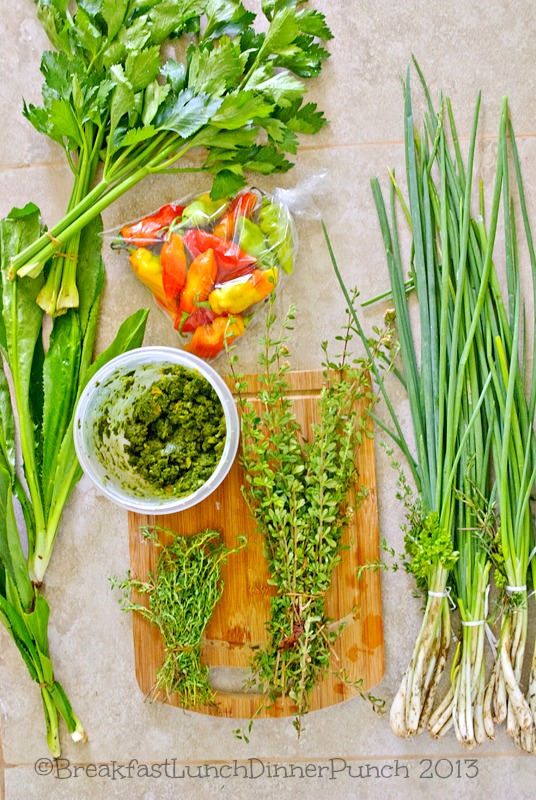
The foundation of cooking meat the Trinidadian way is all about the seasoning. All meat (beef, chicken pork and fish) is marinated in a seasoning mix of crushed herbs, onions, garlic and peppers. This blend of herbs and aromatics is called 'green seasoning'. It is incredibly versatile and is good in soups, stews, rice, and bean dishes. Many Trinidadians whip up a batch of this stuff on a weekly basis. The blend of seasoning is based on personal preference and varies across households. Traditionally some or all of the following ingredients are used: 


 Celery 
There are three kinds of celery that are grown for cooking purposes.
Stalk celery is imported into this country from America and it is grown for its crunchy stalks which can be eaten raw. 

Leaf celery (pictured above) or Chinese celery is grown primarily for its leaves which are used as a herb. The stem is also edible raw but much more pungent than stalk celery. The stalks of leaf celery taste better cooked. This type of celery is a key ingredient in Trinidad green seasoning and both leaf and stalks are used.

Root Celery also called celeriac is grown for its bulbous root. It is not available in Trinidad.


Culantro
The Trinidadian name for culantro (Eryngium foetidum) comes from french settlers to the island during colonial rule. Chardon béni which Trinis pronounce as shadow benny means blessed thistle. Although not the same plant it's appearance is somewhat remniscent of the blessed thistle plant (Cnicus benedictus) that is native to southern France. 

Bhandhania is the other local name for culantro and it comes from the large East Indian descended population. Dhania comes from the Hindi word for coriander seed. It must be noted that culantro is not related to the coriander plant (Coriandrum sativum). Interestingly, both plants have the same smell and taste with culantro being the more intensely flavoured of the two. Use twice as much cilantro if substituting it for chardon béni in your recipe. 

Across the Caribbean it is also known as Chardron benee (Dominica), coulante (Haiti), recao (Puerto Rico) and fit weed Guyana).


Portuguese Thyme

I expect that I might be the last remaining Trinidadian who remembers that this was once called Portuguese thyme, so called because this is used in Garlic Pork (the local version of Carne de Vinagre e Alhos). Garlic Pork is a traditional Portuguese West-Indian Christmas dish.  Over the years Trinidadians started calling this Spanish Thyme which is very confusing because there is another herb that is also called Spanish thyme. 


I remember consulting my grandparents the very first time I made garlic pork. I have fond memories of my 2nd generation Portuguese grandparents guiding me through the process and instructing me that I was to use Portuguese thyme. It is also called by this name in the first locally published cookbook, Sylvia Hunt's cooking: Proud Legacy of our people. Whatever the correct name might be, I will continue calling this herb Portuguese thyme if only for sentimental reasons and remembrances of my grandparents. 


So that there can be no confusion, its botanical name is Lippia micromera and it also goes by the name of False Oregano. In the United States it's called Mexican Oregano. Even thought it smells and tastes very similar to true oregano, the plant is actually more closely related to lemon verbana. The flavour is a little more intense than true oregano so a little goes a long way. 


French Thyme (thymus vulgaris) 


Spanish Thyme (Big Leaf Thyme)

The final variety of thyme that Trinidadians love to throw into this mix is Spanish Thyme (Plectranthus amboinicus). Yet another thyme that is not a thyme but we call it thyme anyway. Yikes!  It's other local name is big leaf thyme because of its broad leaves. I don't often include this one in my green seasoning mix. 


Still confused by the various types of thyme. Here is a photo taken from the blog of my good friend Cynthia and used with her kind permission. This should make it easier for you to identify the different varieties.

Spanish thyme is another herb with an oregano-like flavour. It is even more strongly flavoured than Portuguese thyme and because of the similarities I find it unnecessary to use both at the same time. It can overpower if used too liberally. When I do use it, it's never more than a leaf or two as it has the tendency to darken the seasoning mix and turn dark green to black. I prefer to see a brighter green mix.


In Trinidad no distinction is made between Green onions or scallions and chives. They are all called chives (local pronunciation Sigh-ve ) and are used interchangeable in the making of green seasoning. My preference is for  the slightly more onion flavour of the scallions for my marinade. 


Trinidad pimento peppers 
Trinidad pimento peppers are also known as seasoning peppers. I would have to say that pepper is adored by Trinidadians and is easily the most popular cooking pepper in our country. Unfortunately it is little known outside of the Caribbean or places that have a large West Indian population. The flavour is really impossible to describe. When you cut it it smells like its going to be hot and I suppose it can be said to have the flavour of a hot pepper but without the heat if that makes sense. It is most definitely not a sweet tasting pepper like a bell pepper. Some people will also use scotch bonnet peppers. 

Before I begin, let me assure you that there are no standard amounts for this recipe. I usually judge if it is right by smell not taste. After awhile you will develop a sense of what is right for you. 


Trinidad Green Seasoning
Yeild 9 ( approx 2 cups)

4 bunches leaf celery
2 bundles culantro ( or 4 bunches cilantro)
1 bundle Portuguese thyme - 12 stalks or so ( or substitute with oregano )
2 bundles French thyme
3 bundles of scallions (or chives)
10-12 Trinidad Pimento peppers ( substitute banana peppers)
2 leaves of big leaf thyme (optional)
1 head of garlic ( about 10 cloves)
1/8 - 1/4 cup water or *vinegar  (*optional-  this preserves the seasoning mix if it is to be kept in the fridge longer than a week) 


Method
Wash the herbs and de-seed the pimento peppers.
Rough chop all ingredients and put into a food processor or blender.  Puree the herbs adding a small amount of water, vinegar or lime juice so that mixture can turn easily in the processor. The consistency should be that of a chunky pesto. Some people prefer a more watery blend it's up to you. 

Green seasoning can also be frozen in an ice tray. You pop out a cube or two when needed. If freezing you can omit the vinegar. You will find that over time the colour darkens in the fridge. This is normal and it is perfectly fine.